
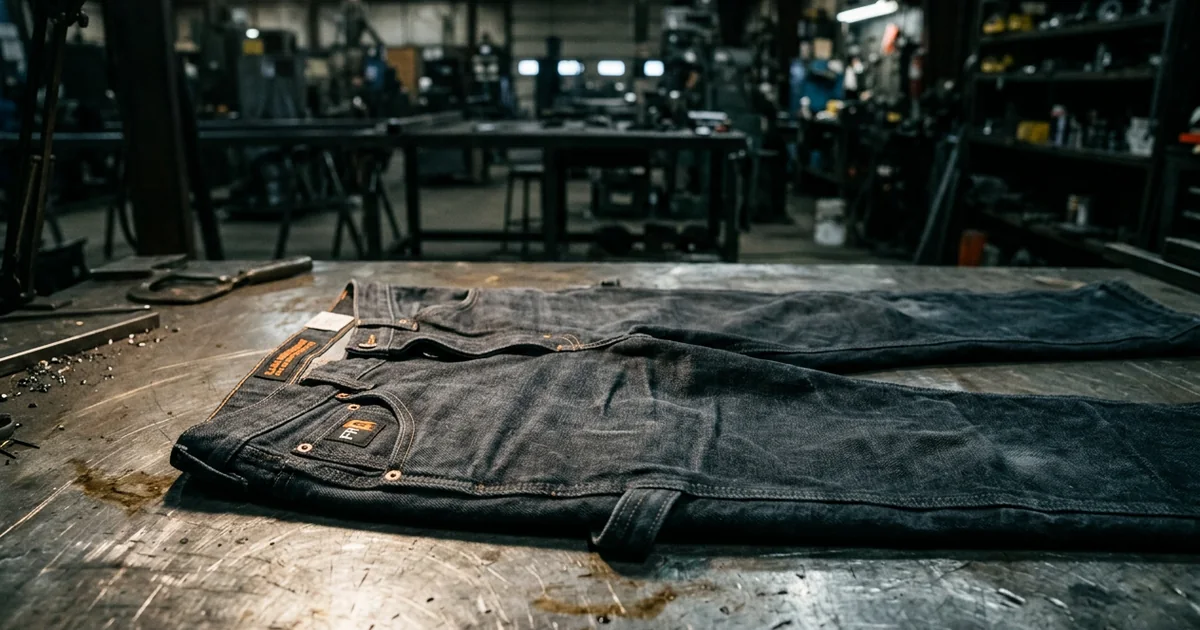
Wrangler FR and its rugged RIGGS Workwear sibling are some of the best-value arc-rated jeans you can buy: heavyweight 100% cotton denim with a real, verified arc rating in the 23.7–23.8 cal/cm² range, full NFPA 2112 certification, and a sub-$85 price that undercuts most premium FR brands. The catch is the trade-off baked into all-cotton FR — 14.5 to 14.75 oz denim runs hot in summer, there's no stretch, and it's treated FR, so the protection lasts only if you launder it right. Treated FR means flame resistance is a finish applied to cotton, not a built-in fiber property — it still certifies to NFPA 2112 and lasts the garment's life when cared for correctly.
Key Takeaways
- The arc rating is genuinely high: the Wrangler jeans I checked state ATPV 23.7–23.8 cal/cm² — well above the 8 cal/cm² CAT 2 floor, and among the highest you'll find on a denim work jean.
- It's documented, not "FR-look": the listings name NFPA 2112, and the RIGGS carpenter jean also lists NFPA 70E, ASTM F1506 and OSHA 1910.269 — the paperwork a real arc-flash buyer should see.
- Value is the headline: $77.99 to $80.99 for a 23+ cal jean is strong pricing — many premium FR brands charge more for a lower rating.
- It's heavyweight, treated cotton: 14.5–14.75 oz, 100% cotton, no stretch. Tough and protective, but warm in heat and stiff before break-in.
- Pick by cut: RIGGS FR3W020 for tool-carrying work, FR13MWZ for a classic original-fit look, FR31MWZ when you need a roomier relaxed fit.
Are Wrangler FR jeans worth it?
For the money, yes — and I don't say that loosely. The question buyers really ask about Wrangler FR is whether a sub-$85 jean buys real protection or just a label, and on the spec sheet these clear the bar with room to spare. The RIGGS FR3W020 carpenter jean states ATPV 23.7 cal/cm², and both the FR13MWZ original-fit and FR31MWZ relaxed-fit jeans state 23.8 cal/cm². To put that in context: NFPA 70E CAT 2 starts at an 8 cal/cm² arc rating, so these aren't squeaking past the line — they're sitting at roughly three times the CAT 2 minimum. That's a lot of headroom on a jean that costs less than many CAT 1 shirts.
What you're paying for is honest, too. The listings name the standard — all three meet NFPA 2112, the flash-fire garment standard — and the RIGGS carpenter jean goes further, citing NFPA 70E, ASTM F1506 and OSHA 1910.269. That's the documentation that separates a genuine FR garment from a cheap "FR-look" knockoff, and Wrangler shows it. So the value verdict is simple: if you want a heavyweight denim work jean with a high arc rating and you don't need stretch or summer-weight breathability, the price-to-protection ratio here is hard to beat.
Wrangler FR vs Wrangler RIGGS — what's the difference?
People mix these up, so let me draw the line. Wrangler FR (the FR13MWZ and FR31MWZ jeans) is the classic five-pocket blue-jean line — straightforward denim that happens to be flame-resistant, in original and relaxed fits. Wrangler RIGGS Workwear is the heavier-duty, jobsite-built sub-brand; the FR3W020 is a carpenter jean with a hammer loop and utility/tool pockets, made for guys who hang a tape and a hammer off their hip all shift. Both are FR, both certify to NFPA 2112, and the arc ratings are almost identical (23.7 vs 23.8 cal/cm²). The decision isn't about protection — it's about whether you want a clean jean look (Wrangler FR) or a working carpenter cut with pockets and loops (RIGGS).
| Jean | Fabric / weight | Arc rating | Cut | Price |
|---|---|---|---|---|
| RIGGS FR3W020 | 100% cotton denim, 14.5 oz (treated) | ATPV 23.7 cal/cm² · CAT 2 | Carpenter, hammer loop + tool pockets | $77.99 |
| Wrangler FR13MWZ | 100% cotton denim, 14.75 oz (treated) | ATPV 23.8 cal/cm² · CAT 2 | Original fit (prewash), 5-pocket | $80.99 |
| Wrangler FR31MWZ | 100% cotton denim, 14.75 oz (treated) | ATPV 23.8 cal/cm² · CAT 2 | Relaxed fit, roomier seat/thigh | $80.99 |
1. Wrangler RIGGS FR3W020 Carpenter Jean — best for tool-carrying work
This is the one I'd put on a working tradesman first. The listing states 14.5 oz 100% cotton FR denim with FR Nomex thread in the seams, ATPV 23.7 cal/cm², and a four-standard stack: NFPA 2112, NFPA 70E, ASTM F1506 and OSHA 1910.269. On top of the protection you get the carpenter build — a hammer loop and utility/tool pockets designed for full shifts of jobsite wear. At $77.99 it's the cheapest jean of the three and arguably the most useful if your hands are full of tools.
- Pros: high 23.7 cal/cm² arc rating; four-standard compliance; genuine carpenter utility loops and pockets; lowest price here.
- Cons: heavy 14.5 oz all-cotton denim runs hot and stiff before break-in; no stretch; treated FR, so it depends on correct laundering over its life.
Check price at Working Person's Store →
2. Wrangler FR13MWZ Original Fit Jean — best for the classic blue-jean look
If you want an FR jean nobody clocks as safety apparel, this is it. The listing states 14.75 oz 100% heavyweight cotton FR denim with FR Nomex thread in the seams and zipper tape, prewashed for a broken-in look, in a classic five-pocket original fit. It carries ATPV 23.8 cal/cm² and the same four-standard coverage (NFPA 2112, 70E, ASTM F1506, OSHA 1910.269) for $80.99. One honest fit note: original fit is on the slimmer side through the seat and thigh, so if you're built bigger or want room to move, look at the relaxed FR31MWZ below.
- Pros: looks like a normal pair of blue jeans; prewashed for a softer hand; high 23.8 cal/cm² rating; full standards coverage.
- Cons: original fit runs slim through the seat/thigh; rigid 14.75 oz cotton with no stretch; warm in summer heat.
Check price at Working Person's Store →
3. Wrangler FR31MWZ Relaxed Fit Jean — best for a roomier cut
Same fabric, same rating, more room. The listing states 14.75 oz 100% heavyweight cotton FR denim with ATPV 23.8 cal/cm² and NFPA 2112 — identical protection to the FR13MWZ — but cut relaxed through the seat and thigh. That's the better choice if the original fit feels tight, if you're broader through the legs, or if your work has you crouching, climbing and kneeling all day. Also $80.99. For FR specifically, a roomier jean is no bad thing: a little air gap between the fabric and your skin improves protection, so don't size FR skin-tight.
- Pros: roomier seat and thigh for active work; same 23.8 cal/cm² rating and NFPA 2112 as the original fit; good value at $81.
- Cons: same heavy 14.75 oz all-cotton hand — no stretch and warm in heat; relaxed cut won't suit anyone wanting a trim look.
Check price at Working Person's Store →
Wrangler FR sizing & fit
Wrangler FR jeans carry standard waist-and-inseam sizing, so start with your everyday jean measurements. The real fit decision is the cut, not the number: the FR13MWZ original fit runs slimmer through the seat and thigh, while the FR31MWZ relaxed fit gives you noticeably more room — pick by your build and how much you move. None of these has stretch (they're 100% cotton), so they won't give the way a 2% spandex jean does; if board-stiff denim bothers you, the prewashed FR13MWZ breaks in a touch faster. And a safety reminder that applies to all FR, not just Wrangler: don't size it skin-tight. FR protects best with a small air gap between the fabric and your skin, so when you're between sizes, take the looser one.
Caring for treated FR (so the rating lasts)
Here's the part that decides whether your protection actually lasts the life of the jean. Wrangler FR is treated cotton — the flame resistance is engineered into the fabric and rated to survive the garment's life — but only if you launder it correctly. Skip chlorine bleach, skip fabric softener, skip starch and skip hydrogen peroxide; all of them can interfere with FR performance. Just as important: don't let the denim sit saturated in grease, oil or solvents. Oil-soaked cotton is a fire hazard no matter what FR finish is underneath it. Treated FR isn't fragile, but it's not bombproof either — wash it by the rules and it stays rated. For the full routine, see how to wash FR clothing, and if you're weighing fabric types, inherent vs treated FR lays out the trade-off.
Where Wrangler FR falls short
No jean is the answer for everyone, so here's the honest other side. First, heat: at 14.5–14.75 oz, 100% cotton, these are heavyweight denim, and in real summer heat they run warmer than a lighter blend or an inherent fabric. If you work in the south in July, that weight is a factor. Second, no stretch: all-cotton denim doesn't move with you the way a cotton-spandex jean does — if mobility matters more than maximum durability, a stretch FR jean (Carhartt's Rugged Flex FR or Ariat's DuraStretch lines, for example) will be more comfortable, though often at a higher price and sometimes a lower or unstated arc rating. Third, treated, not inherent: the FR is a finish, so aftercare is part of the safety equation. None of these is a dealbreaker — they're the predictable trade-offs of buying a high-rated, heavyweight cotton jean at a value price. Know your job's hazard category before you rely on any single garment, and confirm the exact spec on the live listing before you buy.
Frequently Asked Questions
Are Wrangler FR jeans good?
Yes — they're one of the best values in FR denim. The Wrangler FR and RIGGS jeans I checked state ATPV 23.7–23.8 cal/cm² arc ratings and meet NFPA 2112, well above the 8 cal/cm² CAT 2 minimum, at prices between $77.99 and $80.99. The main trade-offs are heat and stiffness: they're heavyweight 14.5–14.75 oz all-cotton denim with no stretch, and treated FR that needs correct laundering.
What is the arc rating of Wrangler FR jeans?
The Wrangler RIGGS FR3W020 carpenter jean states ATPV 23.7 cal/cm², and both the FR13MWZ original-fit and FR31MWZ relaxed-fit jeans state 23.8 cal/cm² — all HRC/CAT 2. That's roughly three times the 8 cal/cm² CAT 2 floor under NFPA 70E. It is not sufficient on its own for CAT 3 (25 cal) or CAT 4 (40 cal) hazards, so confirm your job's required category before relying on any one garment.
What's the difference between Wrangler FR and RIGGS FR jeans?
Wrangler FR (FR13MWZ, FR31MWZ) is the classic five-pocket blue-jean line in original and relaxed fits. Wrangler RIGGS Workwear (FR3W020) is the heavier-duty jobsite sub-brand, with a carpenter cut, hammer loop and tool pockets. Both meet NFPA 2112 with nearly identical arc ratings (23.7 vs 23.8 cal/cm²), so the choice is about cut and pockets, not protection.
Are Wrangler FR jeans inherent or treated FR?
Wrangler FR jeans are treated FR — the flame resistance is a finish engineered into the 100% cotton denim, not an inherent fiber property like aramid. Treated FR certifies to NFPA 2112 and is rated to last the garment's life, but only with correct care: no chlorine bleach, fabric softener, starch or peroxide, and never let the denim stay saturated with grease or oil.
Are Wrangler FR jeans too hot for summer?
They run warm. At 14.5–14.75 oz, 100% cotton, these are heavyweight denim built for durability and a high arc rating, not breathability, so in real summer heat they're warmer than lighter blends or inherent fabrics. If summer comfort and mobility are your priority, a lighter or stretch FR jean may suit you better, though it often costs more and may carry a lower or unstated arc rating.
Why Trust This Guide
This guide is written and reviewed by Wes Calder, an independent flame-resistant-workwear reviewer. Every recommendation is built on the published standards (NFPA 2112, NFPA 70E, ASTM F1506), manufacturer spec sheets and garment tags, hands-on handling, and what tradespeople actually report — and we tell you when a number is a manufacturer claim versus an independent standard, and when a garment is FR but not arc-rated. We earn an affiliate commission if you buy through some of our links, at no extra cost to you, and we never rank by commission over safety — see our affiliate disclosure.