
If you want to know how to wash FR clothing without wrecking the protection, here's the short answer: wash it inside-out with ordinary detergent, use warm water to flush the oils, and keep four things away from it — chlorine bleach, hydrogen-peroxide bleach, fabric softener, and starch. Do that and the flame resistance stays put. FR clothing is fabric that resists ignition, self-extinguishes, and won't melt onto skin — it is not "fireproof," and it does have a service life.
The question I hear most is some version of "does the FR wash out?" followed by "how do I know it's still rated?" Good instincts. Most of the FR care advice floating around is either a manufacturer's care-tag boiled down to four bullets, or shop-floor folklore that conflates "FR" with "arc-rated." Let me walk through what actually degrades FR in the laundry, what's just a myth, and when a garment is genuinely done — and tell you where I'm reasoning from a standard versus where I'm reporting what tradespeople say.
Key Takeaways
- Inherent FR doesn't wash out — the fiber itself (modacrylic blends, aramids) is flame-resistant. Treated FR is a chemical finish on cotton, engineered to last the garment's useful life if you launder it correctly.
- The four banned products: chlorine bleach, fabric softener, hydrogen-peroxide bleach, and starch. They degrade the FR or leave a flammable residue.
- Warm water (around 140°F) helps flush embedded oils — but the garment's care label is always the tiebreaker.
- Grease/oil saturation makes ANY FR garment a fire hazard. Clean it or retire it — the rating doesn't help once the fabric is soaked in fuel.
- Hard water is the quiet one: dissolved minerals build up in the weave over many washes and reduce FR performance.
- "FR" is not the same as "arc-rated." All arc-rated clothing is FR; not all FR clothing is arc-rated. Laundry can't add an arc rating that was never there.
Does the FR actually wash out?
This is the core worry, so let's split it cleanly, because the answer depends on which kind of FR you own.
Inherent FR means the fiber itself is flame-resistant — modacrylic blends and aramids, for example. The flame resistance is part of the molecule, so it does not wash out. You can launder an inherent-FR garment its whole life and the protection is still in the fiber. The trade-off is up front: inherent fabrics usually cost more, and you're paying for protection that's built in rather than applied.
Treated FR is an FR chemical finish applied to (usually) cotton. Here's the part people get wrong: a properly engineered FR treatment is designed to last the garment's useful life when it's laundered correctly. It is not a coating that rinses off after a few washes. What ruins it isn't normal washing — it's the wrong washing: bleach, softener, and harsh additives that attack the finish. Both inherent and treated FR can certify to NFPA 2112 (the flash-fire garment standard, verified by an ASTM F1930 manikin test at the garment level); the trade-off between them is cost, hand-feel, and durability, not whether one "works."
So the honest version of "does it wash out?" is: no, not from washing it right — but yes, you can absolutely degrade it by washing it wrong. The whole job of a good care routine is making sure "wrong" never happens to a garment you're counting on.
| Inherent FR | Treated FR | |
|---|---|---|
| Where the protection lives | In the fiber itself (modacrylic, aramids) | A chemical finish applied to cotton |
| Does normal washing remove it? | No — it's part of the molecule | No — engineered to last the garment's useful life if laundered correctly |
| What the wrong wash does | Can't strip what was never a finish, but bleach/softener/oil still ruin the garment | Bleach, softener, peroxide and starch attack or coat the finish |
| Can certify NFPA 2112? | Yes | Yes |
| The real trade-off | Higher up-front cost; protection built in | Lower cost; depends on you laundering it right |
How I evaluate an FR-safe wash routine
I'm not running a lab here, and I won't pretend to — I don't burn-test detergents or stage arc-flash exposures on washed garments. What I can do is reason from the published standards and from what welders, linemen and oilfield hands consistently report, and tell you which is which. When I judge whether a wash routine is safe for FR, I'm checking it against five honest criteria:
- Does it keep the four banned additives out? Chlorine bleach, hydrogen-peroxide ("color-safe"/oxygen) bleach, fabric softener, and starch are the non-negotiables. A routine that lets any of them touch FR fails before anything else matters.
- Does it flush oils instead of trapping them? Warm water (commonly cited around 140°F) is recommended specifically because it carries embedded oils out of the weave. A cold-only routine that leaves fuel in the fabric is working against you.
- Does it account for water hardness? Hard-water minerals deposit in the fabric and reduce FR performance over many washes. A routine that ignores hard water slowly degrades the gear regardless of detergent.
- Does it keep FR separate? Washing FR with regular laundry lets non-FR lint and residue ride onto the protective fabric. Inside-out, FR-with-FR is the safe default.
- Does it defer to the garment's own label? The maker tested that fabric. Any general rule — including mine — yields to the care tag when they disagree.
Notice what's not on that list: a special "FR detergent" you're forced to buy. The standard you're actually meeting is "no bleach, no softener" — and plenty of ordinary liquid detergents already clear that bar.
The four things that kill FR in the wash
Memorize this short list. Everything else is detail.
| Avoid | Why it hurts FR | Do this instead |
|---|---|---|
| Chlorine bleach | Degrades the flame resistance | Skip it entirely; pre-treat stains with detergent |
| Fabric softener | Coats the fibers with a flammable residue | Nothing — FR doesn't need it; warm water keeps it from feeling stiff |
| Hydrogen-peroxide ("color-safe"/oxygen) bleach | Also degrades FR — "gentle" on the label, not on the finish | Ordinary liquid detergent, no oxygen-bleach additive |
| Starch | Leaves a flammable coating on the fabric | Iron without starch if you must press it; defer to the label on heat |
That's it. Use a normal liquid detergent and skip those four. There's no exotic "FR-only" detergent you're required to buy — an ordinary detergent without bleach or fabric-softener additives is the goal. The one trap to watch: some "all-in-one" detergent pods and "2-in-1" formulas include a softener or an oxygen-bleach booster baked in, so they fail the rule even though you never reached for a separate softener bottle. Read the additive line, not just the brand. If you do reach for a dedicated FR-safe detergent, you can find them on Amazon, but a plain detergent that meets the no-bleach/no-softener rule does the same job.
How to wash FR clothing, step by step
Here's the routine I'd give a new hire on day one. Defer to the garment's own care label wherever it disagrees — the maker's instructions for that fabric win.
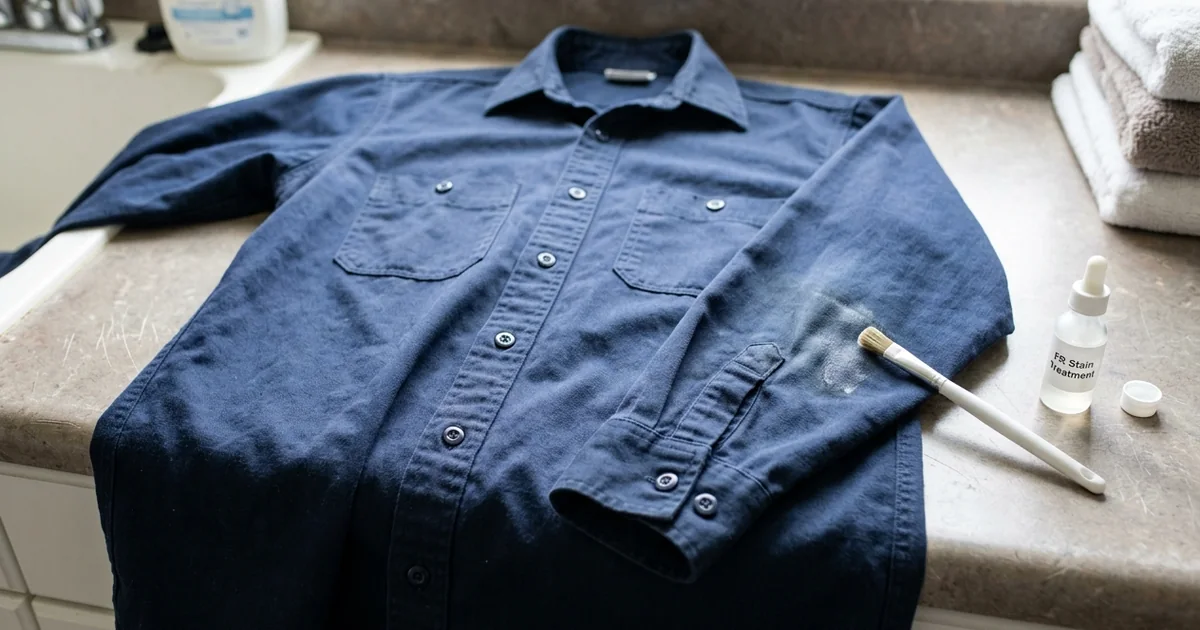
- Pre-treat oil and grease. Spot-clean heavy soiling first. Oil-saturated FR is a fire hazard regardless of the rating, so the goal of washing is partly to flush fuel out of the fabric — not just to get it looking clean.
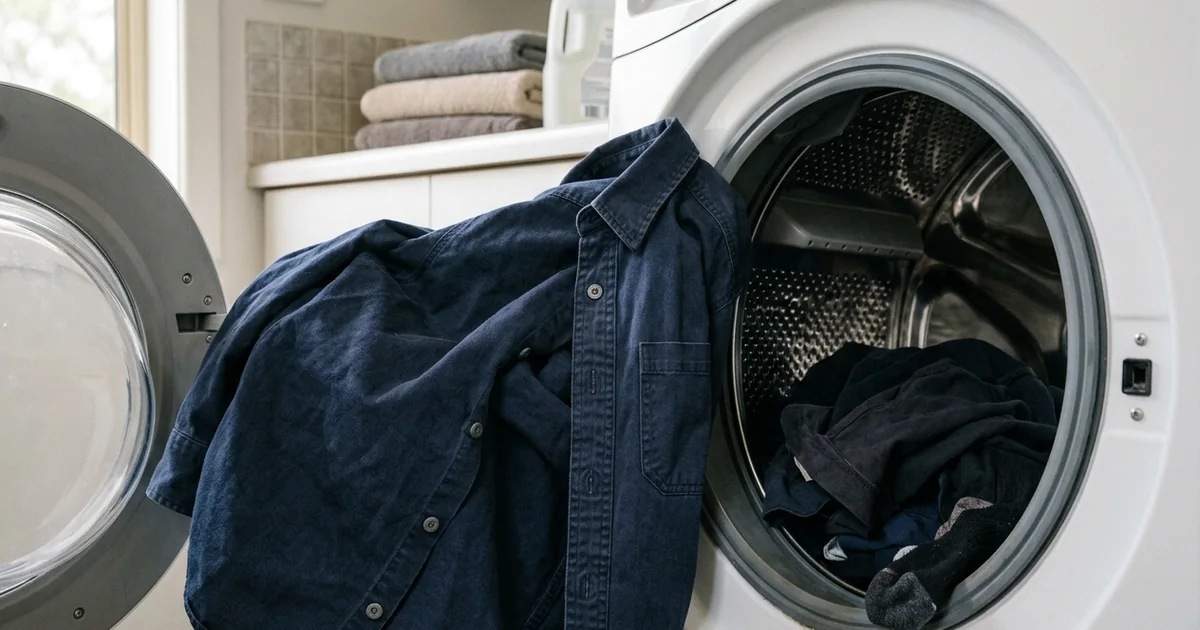
- Turn it inside out and wash FR with FR — keep it separate from your regular laundry so non-FR lint and residue don't ride along onto the protective fabric. Inside-out also protects the face fabric from abrasion, which is what wears a garment to retirement faster than washing ever will.
- Use ordinary detergent and warm water. Many makers recommend warm water (around 140°F) specifically to flush embedded oils out of the weave. Again — the care label is the tiebreaker, and some fabrics call for cooler temperatures.
- Add an extra rinse if you have hard water. Hard water deposits minerals in the fabric that reduce the flame resistance; an extra rinse helps clear them before they build up.
- Dry per the label, then inspect. Dry the way the tag says — over-hot drying is unnecessary wear. Then look for grease saturation, thinning, holes, or charring before it goes back in the rotation.
Hard water, oil, and the things that quietly hurt FR
Two slower killers worth naming, because neither one announces itself. First, hard water: the dissolved minerals deposit on the fabric over many washes and that mineral buildup reduces FR performance. It's gradual — you won't see a single wash do damage — which is exactly why it's easy to ignore. If your tap is hard, an extra rinse cycle is cheap insurance, and it's worth knowing whether your area runs hard before you blame a garment for "wearing out early."
Second — and this is the big one — oil and grease saturation. This is the failure mode that catches people, because a greasy FR shirt still looks like FR. It isn't behaving like it. Once the fabric is saturated with grease or oil, you've effectively soaked your protective layer in fuel, and that makes any FR garment a fire hazard no matter what its tag says. The rating on the label describes the fabric, not the fabric-plus-fuel you're now wearing. The fix is binary: clean it out, or retire the garment. There's no "it's probably fine" with a fuel-soaked FR shirt.
"Is it still rated?" — and which rating you mean
When someone asks me "is it still rated after all these washes," there are really two questions hiding in there, and they're worth separating because washing can't fix a rating that was never on the garment.
FR is not automatically arc-rated. All arc-rated (AR) clothing is flame-resistant, but not all FR clothing is arc-rated. A flash-fire garment (NFPA 2112) and an arc-flash garment (rated in cal/cm² under NFPA 70E, fabric spec ASTM F1506) protect against different hazards. If your job has an electrical arc-flash hazard, you need an arc rating — reported as an ATPV (Arc Thermal Performance Value) or EBT (Energy Breakopen Threshold) in cal/cm², with the garment's rating being the lower of the two — not just the word "FR." That arc rating maps to an NFPA 70E PPE Category: CAT 1 needs at least 4 cal/cm², CAT 2 at least 8, CAT 3 at least 25, and CAT 4 at least 40. (If you've worked in the trade a while: "HRC" was renamed "PPE Category" in the 2015 edition of 70E, which also dropped the old HRC 0.) No amount of correct laundering adds an arc rating that wasn't there to begin with. Match the garment to the hazard before you worry about the wash cycle.
As for whether washing changes the rating: if you've stuck to the rules — no bleach, no softener, no starch, no oil saturation — a treated-FR garment is engineered to hold its certification across its useful life, and an inherent-FR garment never had a finish to lose. What actually ends a garment's rated life is physical wear and contamination, which brings us to the last question.
When do I retire it? (the 18–30 month question)
You'll see service-life numbers thrown around for FR — commonly something in the 18 to 30 month range. Be careful with those: they're owner-reports, what real tradespeople say their gear lasted, not a guaranteed certified lifespan stamped on every garment. A welder running hot, dirty work all day and a maintenance electrician who suits up occasionally will not get the same mileage out of the same shirt. Your number depends entirely on the work, the wash routine, and the contamination.
So instead of trusting a calendar, retire on condition. Pull a garment out of rotation when you see:
- Grease or oil saturation you can't fully clean out — the single most important one.
- Holes, tears, or worn-through thin spots, especially over high-exposure areas like the forearms.
- Charring or scorch damage from a prior exposure — that fabric already took a hit.
- A care label too faded to read — if you can't confirm how to launder it, you can't confirm you're protecting it correctly.
FR resists ignition and self-extinguishes; it does not make a worn-out, fuel-soaked garment safe. When in doubt, retire it. A shirt is cheaper than a burn.
Frequently Asked Questions
Does FR clothing wash out?
Inherent FR doesn't wash out — the fiber itself is flame-resistant. Treated FR is a chemical finish engineered to last the garment's useful life if you launder it correctly. Normal washing doesn't strip it; the wrong products do. Chlorine bleach, hydrogen-peroxide bleach, fabric softener, and starch degrade the FR or leave a flammable residue, so avoid all four.
Can I use fabric softener on FR clothing?
No. Fabric softener leaves a flammable residue on the fibers, which works directly against the flame resistance you're paying for. The same goes for chlorine bleach, hydrogen-peroxide bleach, and starch. Watch for softener or oxygen-bleach hidden in "2-in-1" detergents and pods, too. Use an ordinary liquid detergent with none of those additives, and add an extra rinse if you have hard water.
Do I need a special FR detergent?
No. There's no required "FR-only" detergent — the actual goal is an ordinary liquid detergent with no chlorine bleach, no hydrogen-peroxide bleach, and no fabric-softener additive. Plenty of standard detergents already meet that. Dedicated FR-safe detergents exist and are fine to use, but a plain no-bleach, no-softener detergent does the same job. Read the additive line on "all-in-one" formulas, since some include softener or oxygen bleach.
What water temperature should I use to wash FR?
Many manufacturers recommend warm water, around 140°F, because it helps flush embedded oils out of the fabric — and oil contamination is a real fire hazard on FR. That said, always defer to the specific garment's care label, since fabrics differ and some call for cooler temperatures. Wash inside-out, separate from regular laundry, with normal detergent and no bleach, softener, or starch.
Does hard water affect FR clothing?
Yes. Hard-water minerals deposit in the fabric over many washes, and that buildup reduces FR performance. It's gradual, so it's easy to miss. If your tap runs hard, add an extra rinse cycle to help clear the minerals before they accumulate. It's cheap insurance and a common reason gear seems to "wear out early" when the real culprit is mineral deposits, not the FR itself.
How do I know my FR clothing is still protecting me?
If you've avoided bleach, softener, starch, and oil saturation, a treated-FR garment is built to hold its certification across its useful life, and inherent FR never had a finish to lose. Retire on condition, not a calendar: grease saturation you can't clean, holes or worn-thin spots, charring, or a care label too faded to read all mean it's time to replace the garment.
Does washing FR clothing make it arc-rated?
No. All arc-rated clothing is flame-resistant, but not all FR clothing is arc-rated, and laundering can't add a rating that was never there. An arc-flash hazard needs an arc rating in cal/cm² (ATPV or EBT) under NFPA 70E and ASTM F1506; a flash-fire garment under NFPA 2112 covers a different hazard. Match the garment to the hazard before you worry about the wash routine.
Why Trust This Guide
This guide is written and reviewed by Wes Calder, an independent flame-resistant-workwear reviewer. Every recommendation is built on the published standards (NFPA 2112, NFPA 70E, ASTM F1506), manufacturer spec sheets and garment tags, hands-on handling, and what tradespeople actually report — and we tell you when a number is a manufacturer claim versus an independent standard, and when a garment is FR but not arc-rated. We earn an affiliate commission if you buy through some of our links, at no extra cost to you, and we never rank by commission over safety — see our affiliate disclosure.