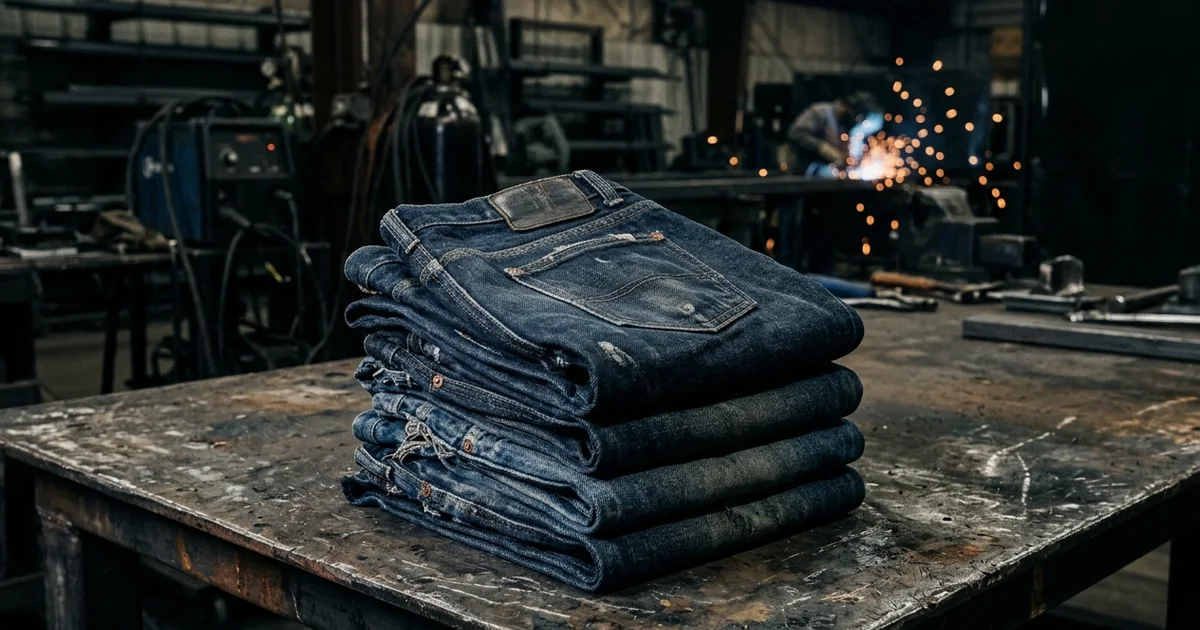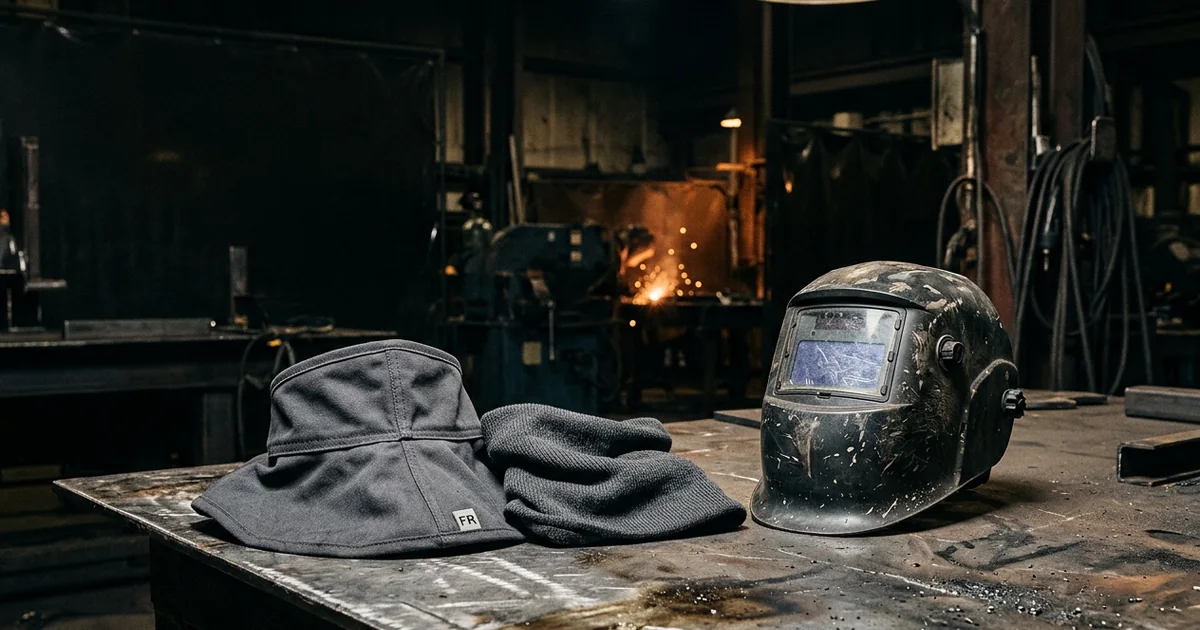

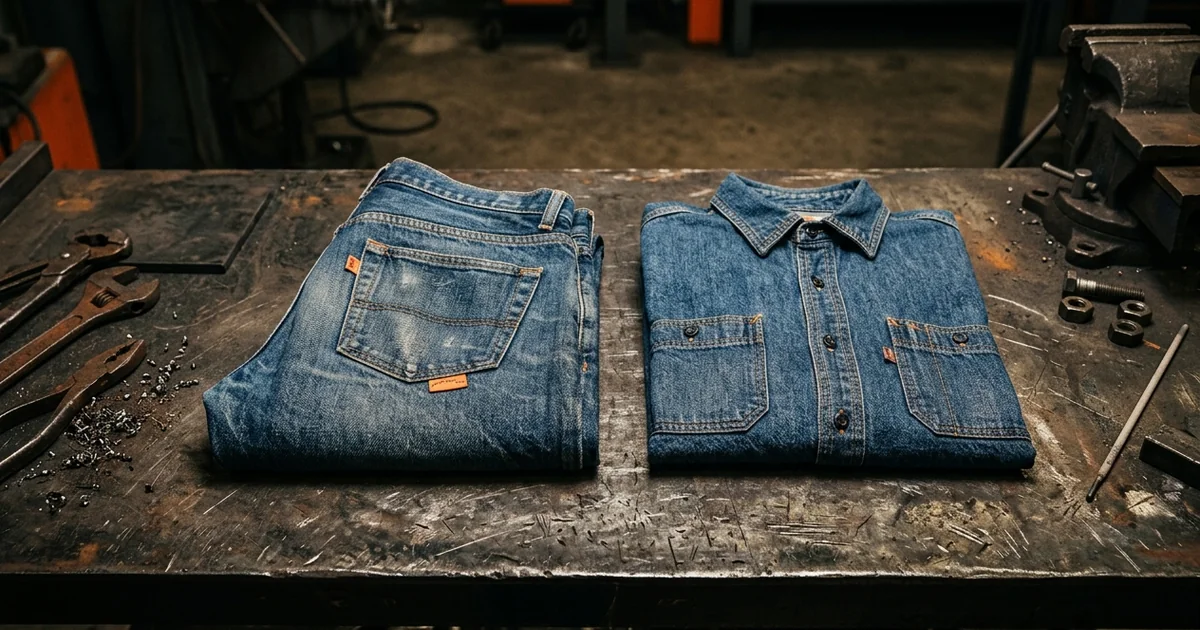
Short answer: regular blue jeans are not flame-resistant. Your everyday Levi's or store-brand denim is 100% cotton, which ignites and keeps burning — it is not FR, no matter how heavy or "rugged" the denim feels. Flame-resistant blue jeans are denim engineered (or chemically treated) so the fabric self-extinguishes when the flame source is removed and won't keep burning against your skin — certified to a standard like NFPA 2112, not just sold as "tough." If a flash fire or arc flash is on your jobsite hazard list, the only denim that counts is denim that names a standard on the tag.
Key Takeaways
- Regular denim is NOT FR: ordinary 100% cotton blue jeans ignite and keep burning. Weight and "heavy-duty" marketing have nothing to do with flame resistance.
- FR denim is treated cotton: the blue-jean FR you can actually buy is cotton denim with a flame-resistant finish that lasts the garment's life — the FR isn't woven into the cotton fiber the way it is in modacrylic or aramid.
- The tag must name a standard: real FR jeans state NFPA 2112 (flash-fire), and often NFPA 70E / ASTM F1506 for arc-flash work. No standard on the tag = not FR.
- FR ≠ arc-rated: all arc-rated denim is FR, but not all FR denim publishes an arc rating. Arc-flash electrical work needs an ATPV in cal/cm², not just "FR."
- Heavier denim isn't automatically safer: a 14.75 oz FR jean runs hotter than a lighter one; pick weight for your climate and the arc rating for your hazard, not by feel.
Are regular blue jeans flame-resistant?
No. The common mistake is assuming that because denim is thick, heavy cotton, it must resist fire. It doesn't. Cotton is one of the most flammable common fabrics — a regular pair of blue jeans will catch, sustain a flame, and keep burning after the ignition source is gone. That's the exact failure mode FR clothing exists to prevent. In a flash fire or arc flash, most serious burns aren't from the event itself; they're from your own clothes continuing to burn against your skin. Plain denim does that. FR denim doesn't.
The "built-like-a-tank" reputation of work jeans makes the trap worse, because heaviness reads as protection. It isn't. A heavy non-FR jean ignites the same as a light one — it just has more fuel to burn. Flame resistance is a property of the fabric chemistry, not the weight. There's no such thing as denim that's "FR enough" because it's tough: it either carries an FR certification or it's a regular pair of pants.
What actually makes denim flame-resistant
Cotton isn't inherently flame-resistant, so FR blue jeans get there one way: a flame-resistant chemical treatment bonded into the cotton denim. Done right, that finish lasts the life of the garment — it doesn't wash out after a few cycles the way a cheap spray-on would. This is "treated" FR, as opposed to the "inherent" FR you get from fibers like modacrylic and aramid that are flame-resistant by their molecular makeup and can't lose it. Both approaches can certify to NFPA 2112; for denim specifically, treated cotton is the route, because the whole point of a blue jean is that it's cotton denim.
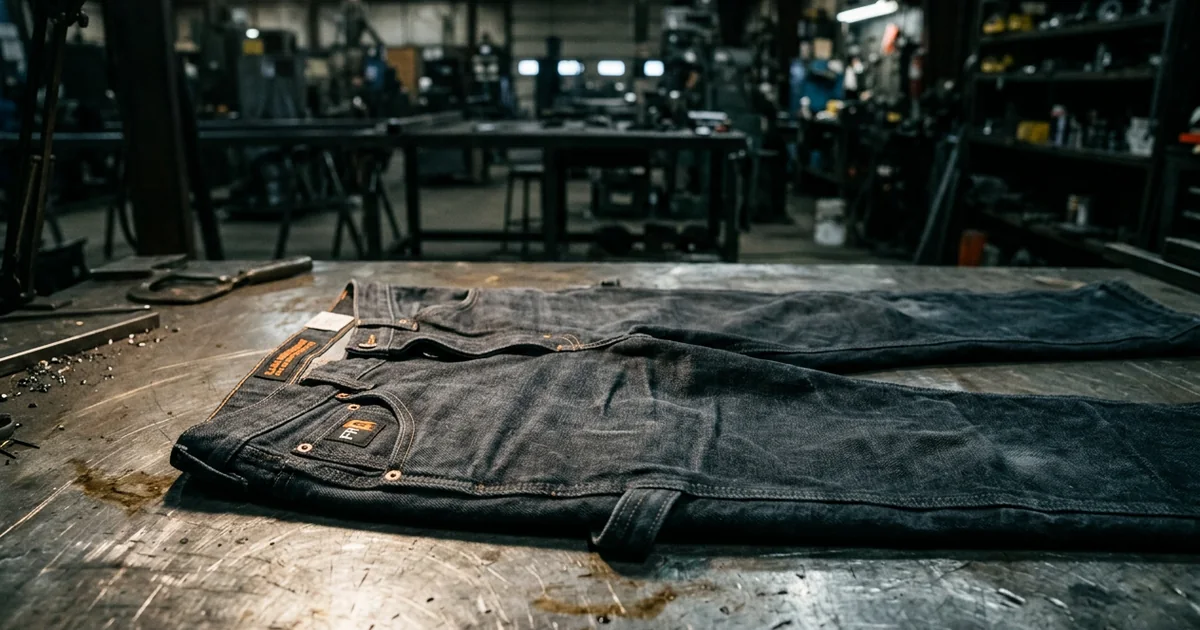
One detail separates real FR jeans from costume denim: the thread. Genuine FR jeans are sewn with FR thread (often Nomex) so the seams don't melt or burn through and split the garment open mid-event. "FR" jeans stitched with ordinary polyester thread aren't FR — the seams become the weak point, and it tells you a maker engineered the garment versus slapped on a label.
For a deeper breakdown of how the two FR types differ in cost, feel, and durability, see inherent vs. treated FR.
How to read an FR-jean tag before you buy
A legitimate pair of FR blue jeans tells you three things on the tag or listing, and a fake tells you none of them:
- A named standard. Look for "NFPA 2112" (the flash-fire garment standard) and, for electrical work, "NFPA 70E" and/or "ASTM F1506." No standard named = not FR, full stop.
- An arc rating, if it's an arc-flash garment. That's an ATPV in cal/cm² and a CAT (category) level — CAT 2 needs at least 8 cal/cm². Some FR jeans publish a number well above their CAT minimum; some only state the CAT. If you do arc-flash work, you need the cal/cm² number to match your job's required level. See FR CAT/HRC levels explained and NFPA 2112 vs. NFPA 70E.
- Fiber and weight. "100% cotton FR denim, 14.75 oz" tells you it's treated cotton and how it'll wear in heat. Heavier protects against abrasion and lasts longer; lighter breathes better in summer.
And the dealbreaker: all arc-rated denim is FR, but not all FR denim is arc-rated. If a jean lists NFPA 2112 but no cal/cm² value, it's certified for flash fire but the manufacturer isn't publishing an arc rating — fine for many oil-and-gas roles, not enough on its own for an arc-flash electrical job. Don't assume the rating you need; confirm it. (Arc-rated vs. flame-resistant walks through exactly when "FR" alone falls short.)
Two honest blue-jean FR picks
This isn't the full roundup — for the complete ranked list across fits, weights, and budgets, see the best FR jeans guide. But if you just want the short list of blue jeans that actually meet the standard, here are two that bracket the trade-off between protection and comfort.
| Pick | Fabric / weight | Rating (stated) | Real-world catch | Price |
|---|---|---|---|---|
| Wrangler FR31MWZ | 100% cotton FR denim / 14.75 oz | NFPA 2112; ATPV 23.8 cal/cm², CAT 2 | Heavy, runs hot in summer | $80.99 |
| Carhartt FRB100 | 100% cotton FR denim / 11.75 oz | NFPA 2112 & 70E; ATPV 8+ cal/cm², CAT 2 | Lower arc rating; lighter denim wears faster | $89.99 |
1. Wrangler FR31MWZ Relaxed Fit — best blue-jean look with the highest arc rating
If you want jeans that read like jeans — a real five-pocket relaxed fit, not a stiff utility dungaree — and you want the most arc protection in a denim cut, this is the one I'd point most people to. It's 100% cotton FR denim at 14.75 oz, treated FR with FR Nomex thread in the seams, meets NFPA 2112, and publishes an ATPV of 23.8 cal/cm² at CAT 2 — the highest published arc rating among the blue jeans I'd recommend. The relaxed fit gives you room in the seat and thigh for squatting and climbing.
The honest catch is heat. Heavyweight 14.75 oz all-cotton denim runs warm, and in July it'll let you know. There's no stretch either — it's rigid until you break it in. For hot-weather, light-duty work, the comfort trade may not be worth the extra cal/cm² you'll rarely tap.
- Pros: classic relaxed blue-jean fit; highest published arc rating here (23.8 cal/cm²); NFPA 2112 with FR seam thread; mid price.
- Cons: heavy 14.75 oz cotton runs hot; no stretch; stiff before break-in.
Check price at Working Person's Store →
2. Carhartt FRB100 Relaxed Fit — best for warm-weather comfort
When the heat is the real enemy, the lighter denim wins. The Carhartt FRB100 is 100% cotton FR denim at 11.75 oz — noticeably lighter on the leg than a 14-ounce jean — and the page states it meets both NFPA 2112 and NFPA 70E at CAT 2, with an ATPV of 8+ cal/cm². For a lot of flash-fire and lower-level arc work in hot conditions, that's the right balance: still certified, far more wearable through a summer shift.
What you give up is at both ends. The published arc rating (8+ cal/cm²) is the lowest of these two, so if your job requires more cal/cm² it's the wrong pick — confirm your required level first. And lighter denim is less abrasion-durable than heavyweight cotton, so it won't outlast a 14 oz jean on a job that's hard on knees and pockets.
- Pros: lightest, most comfortable blue jean here in heat; meets NFPA 2112 and 70E, CAT 2; relaxed fit.
- Cons: lowest published arc rating of the two (8+ cal/cm²); lighter fabric wears faster; priciest of the pair.
Check price at Working Person's Store →
Frequently Asked Questions
Are regular blue jeans flame-resistant?
No. Ordinary blue jeans are 100% cotton, which ignites and keeps burning — they are not flame-resistant regardless of how heavy or "rugged" the denim is. Only denim that's chemically treated for FR and certified to a standard like NFPA 2112 counts as flame-resistant. Weight and toughness have nothing to do with it.
What makes a pair of jeans FR?
Cotton isn't inherently flame-resistant, so FR blue jeans are cotton denim with a flame-resistant chemical treatment bonded into the fabric that lasts the garment's life. Genuine FR jeans are also sewn with FR thread (often Nomex) so the seams don't melt or burn through, and they carry a named standard such as NFPA 2112 on the tag.
Are FR jeans automatically arc-rated?
No. All arc-rated denim is FR, but not all FR denim is arc-rated. A jean can meet NFPA 2112 for flash fire without publishing an arc rating. For arc-flash electrical work you need an ATPV in cal/cm² and a CAT level that matches your job — confirm the number rather than assuming "FR" is enough.
Does the FR wash out of treated denim?
A properly engineered FR treatment is bonded to last the life of the garment, not a few washes — but only if you launder it correctly. No chlorine bleach, no fabric softener, no starch, and don't let the denim get saturated with grease or oil, which is itself a fire hazard. Follow the garment's care tag and our FR washing guide.
Is FR denim fireproof?
No. FR denim resists ignition and self-extinguishes when the flame source is removed, but it's not fireproof — hold enough heat on it long enough and it will char and eventually fail. FR is rated for a sudden, short-duration exposure like a flash fire or arc flash, buying you seconds to get clear. It is not gear for standing in a fire.
Why Trust This Guide
This guide is written and reviewed by Wes Calder, an independent flame-resistant-workwear reviewer. Every recommendation is built on the published standards (NFPA 2112, NFPA 70E, ASTM F1506), manufacturer spec sheets and garment tags, hands-on handling, and what tradespeople actually report — and we tell you when a number is a manufacturer claim versus an independent standard, and when a garment is FR but not arc-rated. We earn an affiliate commission if you buy through some of our links, at no extra cost to you, and we never rank by commission over safety — see our affiliate disclosure.