
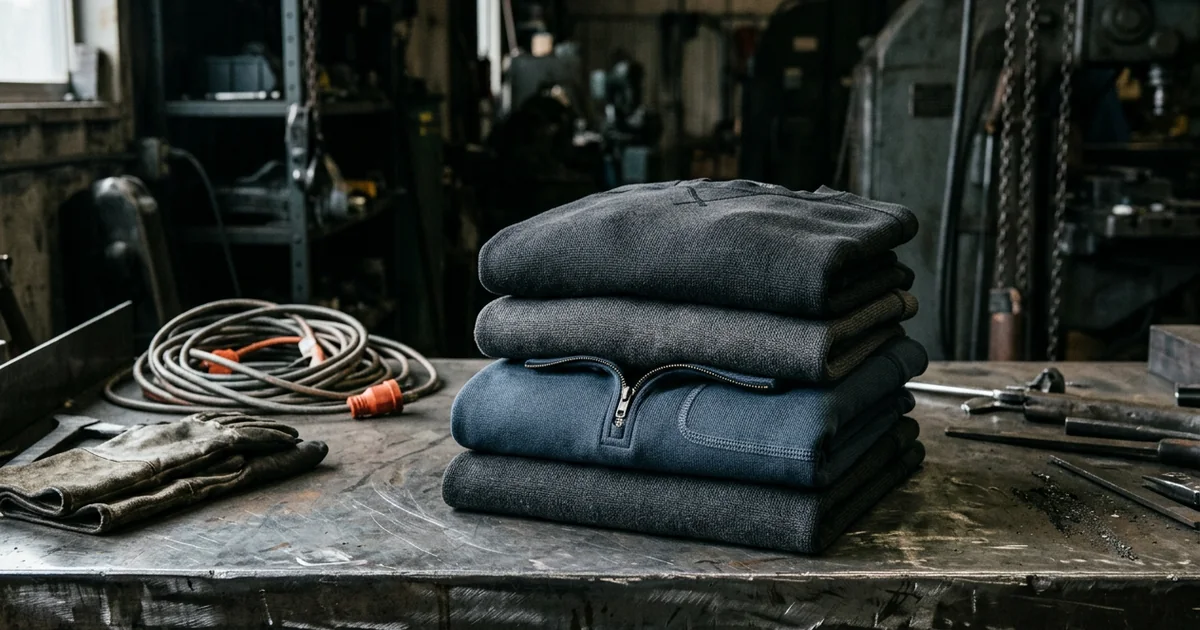
If you want a single answer, the Carhartt 105012 Rain Defender FR Mock-Neck Fleece Pullover is the closest thing here to a real FR sweater rather than a hooded sweatshirt — an inherent modacrylic/aramid blend, a clean half-zip mock neck, and CAT 2 protection. But "best" genuinely depends on your hazard: a knit pullover with a stated CAL 8+ beats a fleece on arc numbers, a hood adds coverage but stops being a sweater, and a 100% cotton FR fleece is treated, not inherent. What is FR clothing? Fabric engineered to resist ignition, self-extinguish once the flame source is gone, and not melt onto skin — it is not "fireproof." Below I rank five real pullovers on fiber, warmth, and arc rating where the listing actually states it.
Key Takeaways
- Inherent beats treated for durability. Modacrylic/aramid blends keep their flame resistance for the life of the garment; 100% cotton FR relies on a finish that depends on correct washing — see our FR wash guide.
- NFPA 2112 ≠ an arc rating. NFPA 2112 covers flash fire; an arc rating (ATPV in cal/cm²) is a separate test, and most of these pullovers don't publish one. Where it's stated, I quote it; where it isn't, I write "—."
- A sweater is not a hoodie. Only the mock-neck fleece and the discontinued knit are true sweater cuts. If you specifically want a hood, my FR hoodie guide covers that category properly.
- CAT/HRC tells you the arc band. CAT 1 ≥ 4, CAT 2 ≥ 8, CAT 3 ≥ 25, CAT 4 ≥ 40 cal/cm². A pullover labeled CAT 2 with no number is at least 8 cal/cm², not a specific tested value.
- Layer FR over FR. A pullover is a mid-layer; match it to an FR base shirt so you're not putting a meltable cotton tee underneath.
How I ranked these (protection first, not commission)
I only quote a spec when the product listing actually states it. If a listing doesn't publish an ATPV cal/cm² number, a fabric weight, or whether the fiber is inherent or treated, I write "not stated" or "—" rather than borrowing a number from a different model — that's exactly how people end up trusting a garment for a hazard it was never tested against. My ranking order is protection first (fiber type, stated standards, stated arc band), then value, then fit and cut. I don't rank by what pays the most; I rank by what I'd actually wear in front of a hazard. NFPA 2112 means flash-fire tested; an arc rating is a separate cal/cm² test, and I never imply one a listing doesn't state.
| Pick | Fabric / weight | Arc rating (if stated) | Best for | Price |
|---|---|---|---|---|
| 1. Carhartt 105012 Mock-Neck Fleece | 10.5 oz; 46% lyocell / 37% modacrylic / 14% aramid / 3% spandex (inherent) | — (CAT 2; ATPV not stated) | True FR sweater cut, layering | $199.99 |
| 2. Carhartt FRK127 Knit Pullover | 14 oz knit; 58% cotton / 35% modacrylic / 7% polyester (inherent) | CAL 8+ (CAT 3 / HRC 3) | Warmest knit, arc work | not stated (out of stock) |
| 3. Carhartt 104983 Force Hooded Pullover | 10.5 oz; 40% cotton / 35% modacrylic / 15% viscose / 8% aramid / 2% antistat (inherent) | — (CAT 3; ATPV not stated) | Higher category with a hood | $154.99 |
| 4. Carhartt 105284 Women's Force Hooded | 10.5 oz; 40% cotton / 35% modacrylic / 15% viscose / 8% aramid / 2% antistat (inherent) | — (CAT 3; ATPV not stated) | Women's cut, midweight | $164.99 |
| 5. Ariat 10032829 Rev Pullover Hoodie | 10 oz; 100% cotton FR fleece (treated) | CAL 8+ (CAT 2) | Reversible comfort, value | $159.95 |
1. Carhartt 105012 Rain Defender FR Mock-Neck Fleece Pullover — best for a true FR sweater cut
This is the one piece in the group that wears like a sweater instead of a hooded sweatshirt: a half-zip mock neck in a 10.5 oz fleece. The fabric is a 46% lyocell / 37% modacrylic / 14% aramid / 3% spandex blend, so the flame resistance is inherent to the fiber and won't wash out over time. It meets NFPA 70E / ASTM F1506 and is UL classified to NFPA 2112 at CAT 2. The honest limit: no ATPV cal/cm² is published, so I treat it as flash-fire and CAT-2-band protection, not a known arc value.
- Pros: True mock-neck sweater cut that layers cleanly under a coat; inherent modacrylic/aramid blend; both NFPA 2112 and ASTM F1506 stated; a touch of stretch from the spandex.
- Cons: Priciest pick at $199.99; ATPV not stated, so don't assume a specific arc value; CAT 2 is a step below the CAT 3 hooded options.
Check price at Working Person's Store →
2. Carhartt FRK127 Knit FR Pullover — best for warmth and a stated arc band
If you want the most sweater-like, warmest knit here, this 14 oz knit pullover is it, and it's the only true sweater cut that publishes an arc band: CAL 8+, which puts it at CAT 3 / HRC 3. The fabric is 58% cotton / 35% modacrylic / 7% polyester — an inherent FR blend, though mostly cotton, so it won't have the wash-life of a higher-modacrylic fabric. ASTM and NFPA 70E are stated; NFPA 2112 is not. The real catch is availability: the page is live but currently out of stock and discontinued by the manufacturer, so I rank it on merit while flagging that you may not be able to buy it.
- Pros: Heaviest, warmest knit (14 oz); stated CAL 8+ at CAT 3; genuine sweater cut, no hood; inherent modacrylic content.
- Cons: Out of stock / discontinued — may be unavailable; NFPA 2112 not stated; mostly cotton, so lower modacrylic share than the fleece picks; price not stated.
Check price at Working Person's Store →
3. Carhartt 104983 Force FR Hooded Pullover — best for a higher category with a hood
Strictly speaking, a hood pushes this out of "sweater" territory, but it earns a spot because it's the highest-rated blended pullover here: CAT 3, with both NFPA 70E / ASTM F1506 and NFPA 2112 stated. The 10.5 oz fabric is 40% cotton / 35% modacrylic / 15% viscose / 8% aramid / 2% anti-static — a modacrylic/aramid blend that behaves as inherent FR. No cal/cm² is published, so the CAT 3 label tells you the arc band (≥ 25 cal/cm²) but not a tested ATPV. If you specifically want a hood, I'd cross-shop my full FR hoodie guide before deciding.
- Pros: CAT 3 — highest category among the blended picks; NFPA 2112 and ASTM F1506 both stated; built-in anti-static fiber; good value at $154.99.
- Cons: It's a hoodie, not a sweater; ATPV not stated; cotton is the largest single fiber, below the mock-neck fleece's modacrylic share.
Check price at Working Person's Store →
4. Carhartt 105284 Women's Force FR Hooded Sweatshirt — best women's-cut pullover
This is the only women's-cut FR pullover in the group, a relaxed midweight zip-front hooded sweatshirt in the same proven 10.5 oz, 40% cotton / 35% modacrylic / 15% viscose / 8% aramid / 2% antistat blend as the men's Force hood. The spec table labels it NFPA 2112 / CAT 3, and the modacrylic/aramid content makes it behave as inherent FR. One honest flag I won't gloss over: the standards text in the listing has a typo — it prints "ASTM F1507" and "NFPA 2113," which aren't the real standard numbers — while the spec table labels NFPA 2112 / CAT 3. Verify the exact standards with Carhartt before relying on it for a specific job hazard.
- Pros: Genuine women's relaxed cut; CAT 3 band per the spec table; same inherent modacrylic/aramid blend as the men's Force; zip front layers easily.
- Cons: Listing's standards text has a typo (F1507 / 2113) — verify before relying on it; it's a hoodie, not a sweater; ATPV not stated.
Check price at Working Person's Store →
5. Ariat 10032829 Rev FR Pullover Hoodie — best for reversible comfort on a budget
The Ariat Rev is a comfortable reversible (two-sided) FR pullover hoodie, 10 oz of 100% cotton FR fleece, and it publishes what most of this category doesn't: a stated CAL 8+ rating at CAT 2, with NFPA 2112 and 70E both listed. The trade-off is the fiber. Cotton is not inherently flame-resistant, so a 100% cotton FR fleece is treated — the protection comes from a chemical finish, and that finish's durability depends on washing to FR-care rules. It's good value and genuinely comfortable, but I rank inherent modacrylic blends above it for long-term wash durability. If you go this route, follow our FR wash guide closely.
- Pros: Stated CAL 8+ (CAT 2) — a published arc band, which is uncommon here; reversible for two looks; soft 100% cotton hand-feel; competitive $159.95.
- Cons: Treated FR, not inherent — protection depends on correct laundering; it's a hoodie, not a sweater; lowest fabric weight in the group at 10 oz.
Check price at Working Person's Store →
Inherent vs. treated FR — does it matter for a sweater?
Yes, and it's the single most useful distinction when you shop FR pullovers. Inherent FR (modacrylic, aramid, and blends of them) builds flame resistance into the fiber itself, so it can't wash out or wear off. Treated FR (a chemical finish on cotton) starts effective but relies on that finish surviving repeated laundering. Both can be certified to NFPA 2112; the difference shows up over months of washing. In this group, the four modacrylic/aramid pieces are inherent, while the 100% cotton Ariat is treated. Neither is "fake" — but if you wash a lot and want set-and-forget durability, lean inherent. And remember: a CAT or HRC label gives you the arc band, not a tested cal/cm² value unless a specific ATPV is published.
Frequently Asked Questions
Is an FR sweater different from an FR hoodie?
Yes. A sweater or pullover has no hood — like the Carhartt mock-neck fleece or the FRK127 knit. An FR hoodie adds a hood for extra coverage but is technically a hooded sweatshirt. Both can carry the same NFPA 2112 certification; the difference is cut and coverage, not the flame resistance itself.
Do FR sweaters have an arc rating?
Only some publish one. An arc rating is an ATPV value in cal/cm² from a separate test, and most of these pullovers don't state it — they list NFPA 2112 (flash fire) and a CAT/HRC band instead. In this guide, only the Carhartt FRK127 and the Ariat Rev state a number (CAL 8+); the others state CAT 2 or CAT 3 with no specific cal/cm² figure.
What does NFPA 2112 mean on a sweater?
NFPA 2112 is a flash-fire standard — it certifies the garment resists ignition and self-extinguishes in a short-duration fire. It does not tell you the arc rating. A sweater can meet NFPA 2112 and still publish no cal/cm² value, so don't assume flash-fire certification implies a specific arc protection level.
What does CAT 2 or CAT 3 mean?
CAT (or HRC) is the arc protection category. CAT 1 means at least 4 cal/cm², CAT 2 at least 8, CAT 3 at least 25, and CAT 4 at least 40 cal/cm². A pullover labeled CAT 3 protects to at least 25 cal/cm², but the label alone doesn't give you the exact tested ATPV unless the listing states a number.
Can I wash an FR sweater normally?
No. FR garments — especially treated cotton like the Ariat Rev — need specific care: no chlorine bleach, no fabric softener, and no high-heat that degrades the finish. Inherent blends are more forgiving but still benefit from FR-correct washing. Follow our FR wash guide so you don't compromise the protection you paid for.
Why Trust This Guide
This guide was written and reviewed by Wes Calder, an independent flame-resistant-workwear reviewer. I rank on protection first — fiber type, the standards a listing actually states, and the arc band where it's published — and I write "—" wherever a spec isn't stated rather than guessing or borrowing a number from another model. We earn a commission on some links, but we never rank by commission over safety — see our affiliate disclosure.