
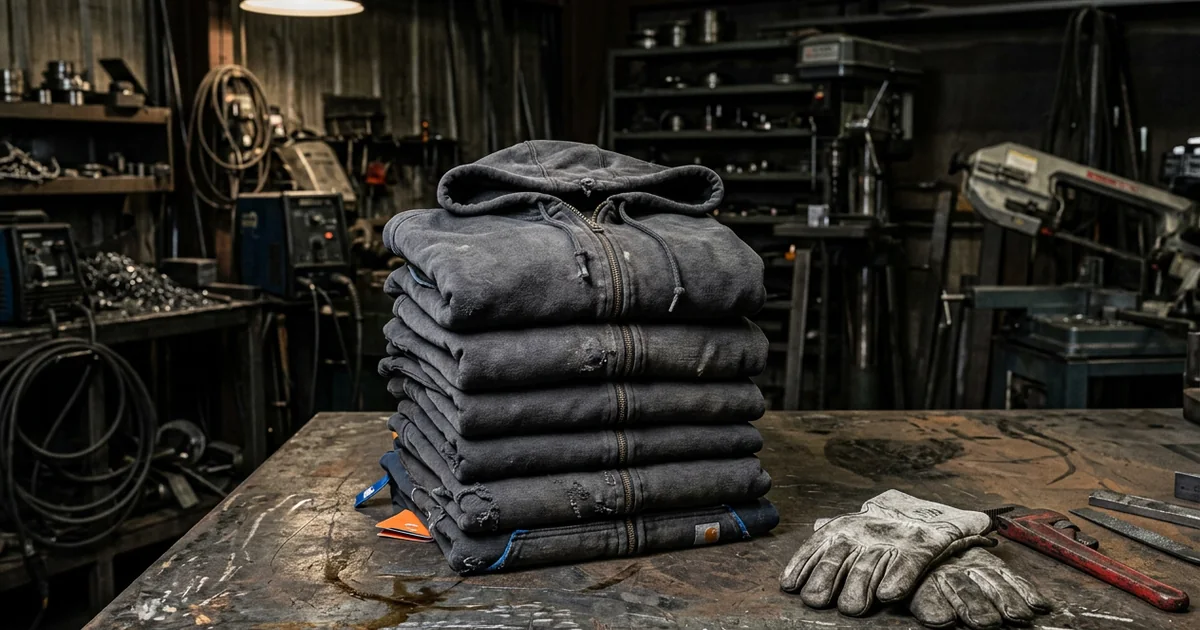
If you want one answer, my pick for the best FR hoodie right now is the Carhartt Force 104982 Flame Resistant Hooded Zip Front Sweatshirt — a 10.5-oz modacrylic/aramid-blend zip-up that the listing documents against NFPA 70E, ASTM F1506, and NFPA 2112 (CAT 3). But "best" genuinely depends on your hazard: if you need a published arc rating on paper, the Bulwark with its stated 17.0 cal/cm² ATPV wins that line; if you want maximum modacrylic content, the Walls leads; if you want a women's cut, Carhartt's 105284 is the only one I can document here. FR clothing is fabric engineered to resist ignition, self-extinguish once the flame source is gone, and not melt onto skin — it is not "fireproof." Below I rank six real, currently-listed FR hoodies on what their listings actually state, not on what sounds good.
Key Takeaways
- NFPA 2112 and an arc rating are two different things. 2112 covers flash fire; an arc rating (ATPV in cal/cm²) covers electric-arc exposure, and only some of these hoodies publish one. If you do electrical work, read our what is FR clothing explainer before you buy on price alone.
- My overall winner is the Carhartt Force 104982 zip-front. It's the best-documented all-around hoodie here — inherent-leaning modacrylic/aramid blend, 10.5-oz midweight, CAT 3 labeling.
- Only one hoodie here states a specific cal/cm² number. The Bulwark lists ATPV 17.0 cal/cm² (HRC 2). For the rest, the cal/cm² figure is "—" because the listing doesn't state it — and I won't borrow a number from another model.
- Heavier means warmer, not safer. The 12.5-oz Bulwark is the warmest; the 10–11-oz options breathe better. Pair any of them with a proper FR jacket for cold-weather layering.
- FR only stays FR if you wash it right. Fabric softener and chlorine bleach can compromise the finish — see how to wash FR clothing.
How I ranked these (protection first, not commission)
My rule is simple: I only quote a spec that the product listing actually states, and I write "—" everywhere it doesn't. If a page doesn't publish an ATPV cal/cm² number, I do not invent one and I do not copy a neighbor's figure to fill the gap — in a safety category that's how people end up under-protected. I ranked these on protection documentation first (NFPA 2112 classification, named standards, stated arc rating), then on value (price for what you get), then on fit and comfort. I earn a commission if you buy through my links, but the order below is built on the merits I just described, not on payout. Where a listing was ambiguous (one automated read of the women's Carhartt page returned standard numbers that look like OCR slips), I flag it and tell you to confirm on the live page rather than paper over it.
| Pick | Fabric / weight | Arc rating (if stated) | Best for | Price |
|---|---|---|---|---|
| 1. Carhartt Force 104982 (zip) | Modacrylic/aramid blend, 10.5 oz | — | Best overall | $164.99 |
| 2. Carhartt Force 104983 (pullover) | Modacrylic/aramid blend, 10.5 oz | — | Best value warmth | $154.99 |
| 3. Carhartt 105284 women's (zip) | Modacrylic/aramid blend, 10.5 oz | — | Best women's cut | $164.99 |
| 4. Walls FRO37355 | 75% modacrylic / 25% cotton, 10 oz | CAL 8+ (CAT 2) | Most modacrylic | not stated |
| 5. Bulwark SEH4 | 95% cotton / 5% Spandex, 12.5 oz | ATPV 17.0 cal/cm² (HRC 2) | Stated arc rating + warmth | $201.99 |
| 6. Ariat FR DuraStretch | 95% cotton / 5% spandex, 11 oz | — | Best stretch/comfort | $219.95 |
1. Carhartt Force 104982 Flame Resistant Hooded Zip Front Sweatshirt — best overall
This is the hoodie I'd hand most people first. The fabric is a 40% cotton / 35% modacrylic / 15% viscose / 8% aramid / 2% anti-static FR fleece at 10.5 oz — a modacrylic/aramid blend that leans inherent rather than a treated cotton finish, though the listing doesn't spell that out in those words. The page states it meets NFPA 70E and ASTM F1506 and is UL classified to NFPA 2112, with Carhartt FR and NFPA 2112 / CAT 3 labels sewn on the pocket. The honest trade-off: no exact ATPV cal/cm² is published, so if your job demands a documented arc rating, look at the Bulwark instead.
- Pros: Best-documented compliance in the group (70E, F1506, 2112, CAT 3); inherent-leaning modacrylic/aramid blend; wearable 10.5-oz weight; zip front is the most versatile cut.
- Cons: No stated cal/cm² number; mid-to-upper price.
Check price at Working Person's Store →
2. Carhartt Force 104983 Pullover — best value warmth
Mechanically this is the same hoodie as my No. 1 in pullover form: identical 40% cotton / 35% modacrylic / 15% viscose / 8% aramid / 2% anti-static blend, same 10.5-oz weight, same stated compliance (NFPA 70E, ASTM F1506, UL classified to NFPA 2112, CAT 3). It's about ten dollars cheaper than the zip. I rank it second only because a pullover is harder to vent when you heat up and slower to remove than a zip front — a real consideration if you're moving in and out of a hot work area. If neither bothers you, the savings are free.
- Pros: Same documented blend and compliance as the top pick; lower price; pullover holds warmth well.
- Cons: No stated cal/cm²; less ventilation and slower to take off than a zip.
Check price at Working Person's Store →
3. Carhartt 105284 Women's Relaxed Fit Zip Front — best women's cut
FR workwear in a real women's pattern is genuinely hard to find, which is why this one earns its spot. It's the relaxed-fit, midweight, zip-front version of Carhartt's FR hoodie — same 10.5-oz, 40% cotton / 35% modacrylic / 15% viscose / 8% aramid / 2% anti-static fleece, and the page references NFPA 70E, ASTM F1506, UL classification to NFPA 2112, and CAT 3 labeling. One honest flag: an automated read of the listing returned "F1507" and "NFPA 2113," which are almost certainly OCR misreads of the standard F1506 and NFPA 2112. I'm not going to state those odd numbers as fact, so confirm the exact standards on the live page before you rely on them. No cal/cm² is stated.
- Pros: Genuine women's relaxed cut; same proven blend and CAT 3 labeling as the men's; zip front.
- Cons: Standard numbers need a manual re-read (likely OCR slip); no stated cal/cm².
Check price at Working Person's Store →
4. Walls FRO37355 Flame-Resistant Work Sweatshirt — most modacrylic
This is the one for people who specifically want a high-modacrylic, inherent-leaning blend: 75% modacrylic / 25% cotton fleece at 10 oz (340 gsm), with a three-piece drawstring hood. Its spec sheet lists NFPA 2112 and 70E and marks ASTM "Yes," and — notably — it's the only hoodie here besides the Bulwark to put an arc-rating floor in writing: CAL "8+," CAT 2 (HRC Level 2). I won't pretend that's a precise ATPV number, because the sheet doesn't give one beyond "8+." The real catch is availability: it showed out of stock when I checked, with no price listed, so treat it as a watch-list pick rather than a buy-today one.
- Pros: Highest modacrylic content (75%); stated CAL 8+ / CAT 2 floor; lightest of the group at 10 oz.
- Cons: Out of stock at fetch; no price stated; exact cal/cm² not given beyond "8+."
Check price at Working Person's Store →
5. Bulwark SEH4 Hooded Zip-Up — best stated arc rating and warmth
If you need a specific, published arc rating on the label, this is the only hoodie in my lineup that gives you one: the listing states an arc rating ATPV of 17.0 cal/cm² (HRC 2), and it's UL classified to NFPA 2112. It's also the warmest here at a heavyweight 12.5 oz (425 g), in a 95% cotton / 5% Spandex brushed fleece. Two honest knocks keep it out of the top tier: it's the most expensive in-stock option, and a 95% cotton/Spandex base is a treated-type FR system rather than the inherent-leaning modacrylic blends above it (the page doesn't state inherent vs. treated outright, but the fiber content points that way). For arc-flash documentation plus cold-weather warmth, though, it's the clear choice.
- Pros: Only hoodie here with a stated ATPV (17.0 cal/cm², HRC 2); warmest at 12.5 oz; UL classified to NFPA 2112.
- Cons: Priciest in-stock pick; cotton/Spandex base implies a treated finish, not inherent.
Check price at Working Person's Store →
6. Ariat FR DuraStretch Full Zip Hoodie — best stretch/comfort
The Ariat is the most comfortable hoodie of the six. Its 95% cotton / 5% spandex, 11-oz FR fleece — the DuraStretch fabric — moves with you in a way the stiffer fleeces don't, and the listing says it meets NFPA 2112 and NFPA 70E certifications and is "permanently flame-resistant." It lands last for two honest reasons: it's the most expensive hoodie here, and the documentation is thinner — no ATPV cal/cm² is stated, and the page doesn't name ASTM F1506. If mobility is your top priority and you don't need a specific arc rating on the label, it's a fair buy; if you're paying a premium, I'd want more on the spec sheet.
- Pros: Most comfortable and stretchiest; NFPA 2112 and 70E stated; mid-weight 11 oz.
- Cons: Highest price; no stated cal/cm²; ASTM F1506 not named on the page.
Check price at Working Person's Store →
NFPA 2112 vs. an arc rating — which one do you actually need?
This trips people up constantly. NFPA 2112 is the standard for flash-fire protection — think oilfield, refinery, anywhere a sudden fuel ignition can engulf you. An arc rating, measured as ATPV in cal/cm² and tied to NFPA 70E and ASTM F1506, is about electric-arc exposure for electrical and utility work, and HRC/CAT categories map to it (CAT 1 ≥ 4, CAT 2 ≥ 8, CAT 3 ≥ 25, CAT 4 ≥ 40 cal/cm²). A garment can be NFPA 2112 classified and still not publish an arc rating, which is exactly the situation with several hoodies above. So match the garment to your hazard: if you face arc flash, prioritize the picks that state an arc value (the Bulwark's 17.0 cal/cm²) or at least a CAT floor (the Walls' CAL 8+), and verify the required category against your site's hazard assessment.
Frequently Asked Questions
Which FR hoodie here is the most protective?
It depends on the hazard. For flash fire, all six are NFPA 2112 classified, and my best-documented overall pick is the Carhartt Force 104982. For electric arc, the Bulwark SEH4 is the only one with a stated arc rating (ATPV 17.0 cal/cm², HRC 2), so it's the strongest on-paper choice for arc-flash work.
Do all FR hoodies have an arc rating (cal/cm²)?
No. NFPA 2112 covers flash fire and is separate from an arc rating. Among these hoodies, only the Bulwark states a specific ATPV (17.0 cal/cm²), and the Walls states a CAL 8+ / CAT 2 floor. The Carhartt and Ariat listings do not publish a cal/cm² number, so I list those as "—" rather than guess.
Are these inherent or treated FR?
The listings don't always say outright. The Carhartt and Walls hoodies use modacrylic/aramid-type blends, which are inherent-leaning fibers, while the Bulwark and Ariat are cotton/Spandex bases that imply a treated FR finish. None of the pages explicitly use the words "inherent" or "treated," so treat that as my read of the fiber content, not a stated claim.
Is there a women's FR hoodie in this list?
Yes — the Carhartt 105284 is a relaxed-fit women's zip-front FR hoodie with the same 10.5-oz modacrylic/aramid blend and CAT 3 labeling as the men's. Confirm the exact standard numbers on the live listing, since an automated read returned what look like OCR slips.
How do I keep an FR hoodie flame-resistant after washing?
Avoid chlorine bleach and fabric softener, which can compromise FR performance, and follow the garment's care tag. Our care guide on how to wash FR clothing walks through the safe routine in detail.
Why Trust This Guide
This guide was written and reviewed by Wes Calder, an independent flame-resistant-workwear reviewer at FR Gear Lab. I rank on what the product listings actually state — NFPA classifications, fabric weight, and arc ratings where published — and I write "—" wherever a spec isn't stated rather than invent one, because in a safety category a wrong number can get someone hurt. We earn a commission on some links, but we never rank by commission over safety. See our affiliate disclosure.